
Delta County Mugshots Record Admission
A mugshot, more precisely a booking photograph, records how a person appeared when an agency admitted or processed that person. It does not record what happened at trial. It does not show whether the charge was dismissed, whether a conviction followed, or whether the person is now held. Release does not change the historical purpose of the image.
Michigan's official FOIA handbook describes a jail booking photograph as a disclosable public record and cites Patterson v Allegan County Sheriff. A Delta County request can therefore name the person, identify the admission or narrow date range, and ask for the related booking photograph. A lawful response can still be affected by an exemption, confidentiality, a set-aside, or another case-specific limit.
A photo should always be paired with the correct case and custodial episode. Similar names, repeat bookings, old images, and later changes in appearance create real identification risks. The release record, court disposition, and present agency status remain separate records.
Delta County Released Mugshot Sources
Official sources do not offer one all-purpose gallery. The channel depends on which agency created the image and whether the record remains public. The table keeps Delta County jail photos apart from MDOC images and explains why status tools or press coverage are incomplete.
| Channel | Photo available? | How to use it |
|---|---|---|
| Delta Sheriff web roster or releases | No official channel found | No county roster, release feed, archive, or gallery was found. |
| DeltaCo Sheriff app | Not advertised | The Tip411 listings describe tips, alerts, and agency updates, not mugshot search. |
| Delta County FOIA | Possible, subject to lawful response | Request the booking photo tied to a named admission and date range. |
| MDOC OTIS | Often, but not always | An MDOC image may appear for a state corrections record and is not necessarily the Delta jail photo. |
| MI-VINE | Variable | Use it for custody status or alerts, not as the official photo archive. |
| Michigan public registry | Only for registrants | A registry image applies only to the statutory registry population. |
| News or agency release | Episodic | An image applies only to the reported event and does not prove the case outcome. |
| Unofficial publishers | Sometimes | Images can be stale, incomplete, or misidentified and are not custody proof. |
Third-party mugshot publishers, data brokers, and paid removal services are intentionally not linked or endorsed. Their copies are not Delta County records. When an official image is inaccurate, use the responsible government custodian and the correction route that matches the source.
Request a Delta County Booking Photo
The Delta County FOIA portal provides the request form, public summary, and procedures. The FOIA Coordinator is located at Delta County Administration, 310 Ludington Street in Escanaba. Requests may be made by email, fax, mail, or in person. The exact county form is available but is not required.
- Give the person's full recorded name and enough identifying detail to distinguish the booking.
- State a narrow admission or booking date range and include a known booking or case number when available.
- Ask for the booking photograph associated with that admission, plus the booking and release identifiers needed to tie the image to the right episode.
- Request a native electronic copy and reasonably separable nonexempt parts if another portion is withheld.
- Ask for a cost estimate if needed, and keep the written response with the image's source information.
Michigan FOIA calls for a response within five business days. The county can grant, deny, partly grant, or send notice of a ten-business-day extension. Permitted fees may reflect search, review, redaction, copying, media, and mailing. Those are possible cost categories, not a quoted price for a Delta County photo.
The official Delta County portal capture shows where the county posts its FOIA materials.
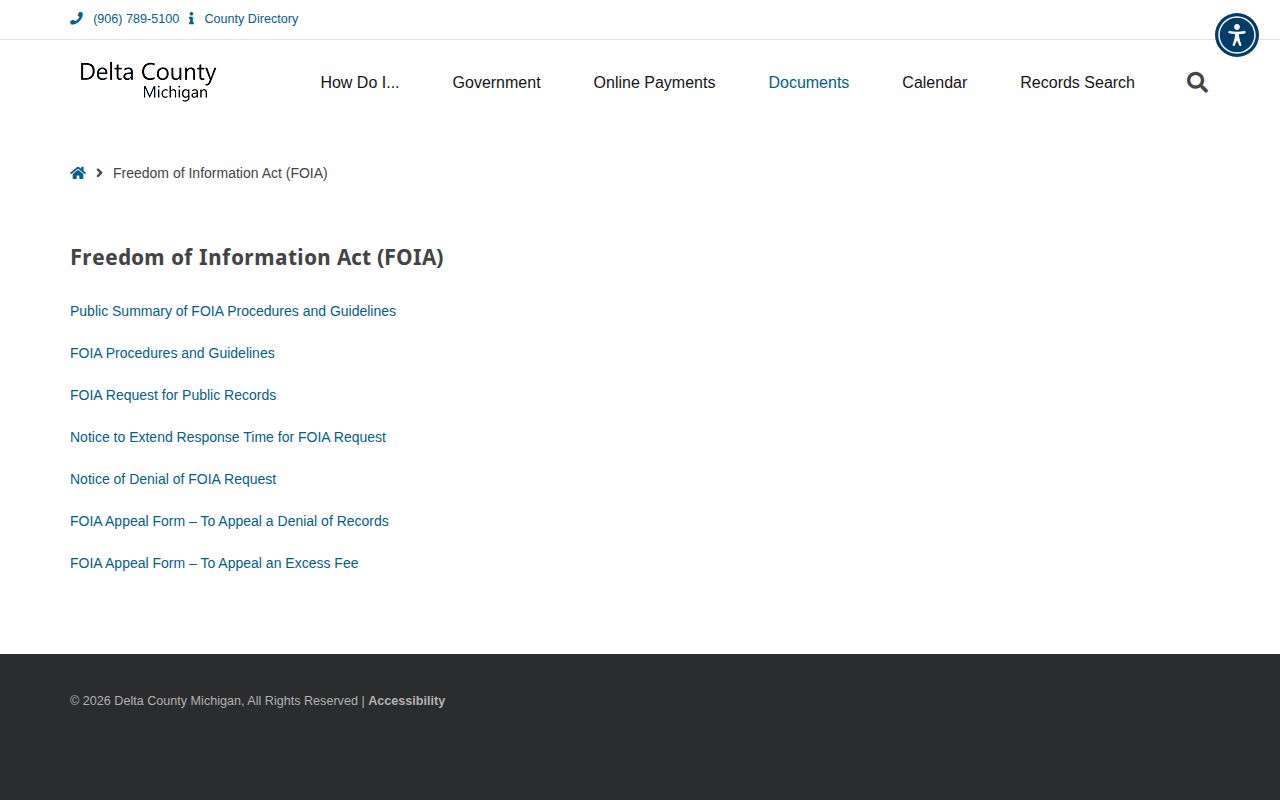
This route seeks the image held by the county rather than relying on an old repost. The response also creates a source trail for the exact booking.
Delta County Mugshots and Custody Status
A booking photo cannot answer whether someone is released. It may remain in a government file long after the jail stay ends. Conversely, no public image does not mean there was no booking. The Delta Sheriff website has no official live roster or release gallery, so an image cannot be found by watching a person drop from such a page.
For a local adult case, the Delta County jail entry documents the actual exit or transfer. The court record supplies the legal event, such as a bond order, dismissal, or judgment. MI-VINE can report a participating agency's custody event. When a transfer to MDOC occurred, OTIS can show state status and an image when one is available. These records complement the photo instead of changing its meaning.
The Delta County released-inmate record route is the right place to verify status. It follows the most recent custodian and then checks the exit, court, and receiving or supervision records.
MDOC Photos After Delta County Release
OTIS is the Michigan Department of Corrections offender search. It can include a public image for a person who entered state corrections, but the image is an MDOC offender photo. It may not be the booking photo made at the Delta County Correctional Facility. Photos can be absent when no electronic image was captured or no image was taken.
OTIS covers current prisoners, parolees, probationers, and people discharged from MDOC supervision within its public retention period. It excludes people sentenced only to a county or city jail. A Delta County jail-only release may therefore produce no OTIS result at all. Read the status before using the image, and do not treat a paroled or discharged label as an explanation of the earlier county booking.
MDOC states that public profiles generally remain online for three years after discharge. The image can remain during that period. An OTIS court-data error belongs with the sentencing court, while a supervision or status question belongs with the supervising office or MDOC. A request for an older public state record can use the MDOC records or FOIA route described by the department.
Delta County Sheriff App Photos
The DeltaCo Sheriff app is a real county communication product, but the store descriptions do not advertise an inmate lookup, recent-release list, or mugshot feature. It is a Tip411 service built around anonymous tips, agency alerts, and web or social information. It should not be described as a jail-photo app.
The official Apple App Store listing shows the advertised functions.
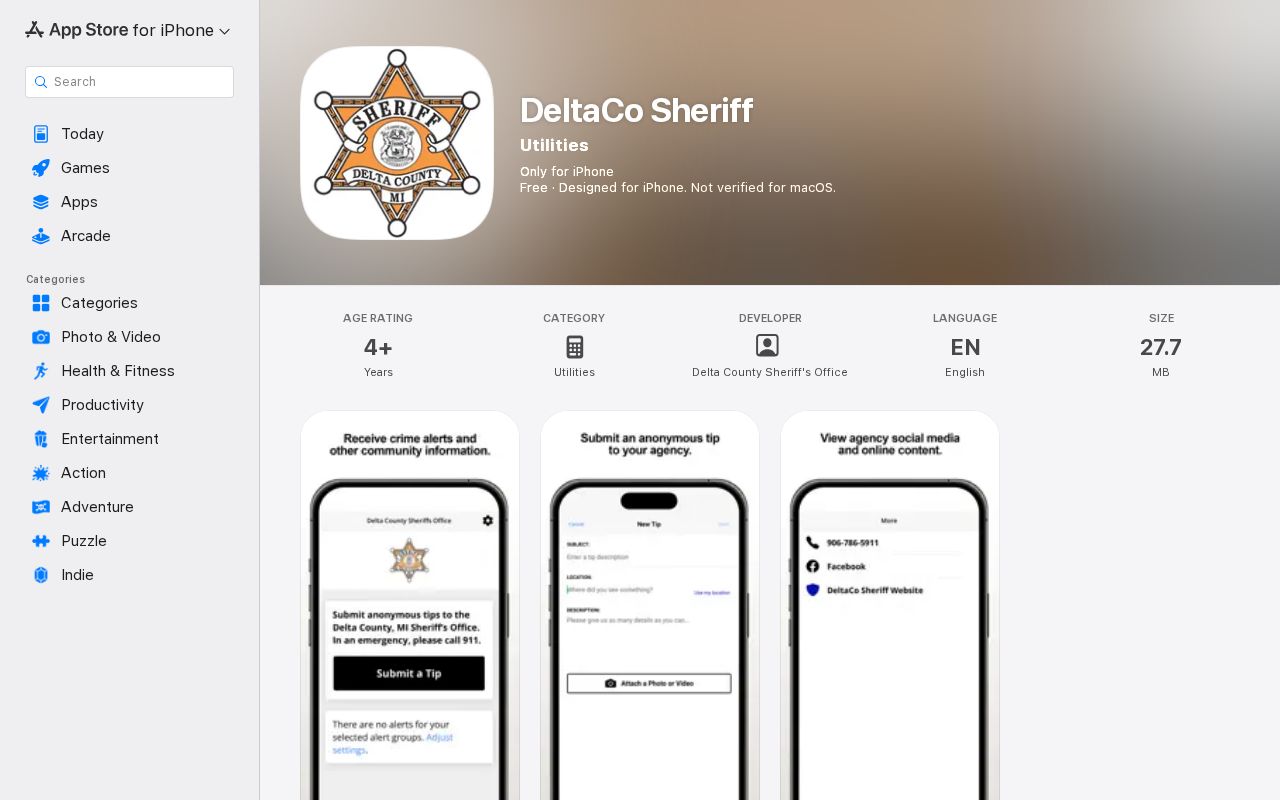
The app may carry a Sheriff alert with an image in a particular event, but that is not a searchable booking-photo archive. The absence of a post or alert says nothing about admission, release, or case outcome.
The Android listing describes the same tips and alert role. Neither official store page supports a promise that a recently released person or booking image can be found in the app. A Delta FOIA request remains the direct official photo route.
Delta County Mugshots in News
Local news and official agency releases may publish an image for a specific event. Such coverage is episodic. A story can omit later dismissal, acquittal, sentence, transfer, release, or set-aside information. An arrest image attached to a report should not be detached from the event date and source context.
The absence of press coverage has no record meaning. Most admissions will not become news. If an image appears in a government press release, use the issuing agency to confirm what the caption said at that time. Then use the court and custody records for later status. No commercial gallery is needed to perform that verification.
Note: A news image documents the event described by its source, while later custody and court outcomes require their own records.
Delta County Mugshots and Clean Slate
Michigan set-aside law can change public access without erasing the fact that an earlier custody event occurred. Under the state's automatic Clean Slate framework, the timing for an eligible felony can run ten years from sentencing or release from MDOC, whichever is later. That makes the MDOC release date relevant to the set-aside clock for some records.
The Michigan courts' automatic set-aside guidance explains the state process. A set-aside generally moves the conviction to retained nonpublic status. A result that later disappears from MiCOURT does not prove that no booking, custody, or release occurred. It shows only that current public access must be understood under the applicable record rules.
OTIS says a profile is removed when the conviction is set aside, expunged, or otherwise removed by operation of law, not merely because someone asks. For an official source error, contact the custodian that controls the field. Court-derived OTIS data should be addressed with the sentencing court. MDOC status or supervision data should be addressed with the department or supervising office.
Delta County Mugshot Removal Limits
No verified Michigan anti-pay-to-remove mugshot statute was found in the official research sweep. That law should not be claimed. An official photo may remain available after release unless a set-aside, confidentiality rule, exemption, correction, or other legal change affects access. The right contact depends on which agency owns the record.
- Delta booking image
- Contact Delta County, identify the admission, and state the legal or factual basis for correction or restricted access.
- OTIS image or status
- Use the sentencing court for court-data errors and MDOC for department or supervision fields.
- Court record
- Use the court that holds the file and follow the applicable set-aside or correction process.
- Unofficial copy
- The publisher controls its own copy subject to applicable law; no paid removal service is endorsed.
The photograph should remain tied to its source, date, and limits. Reposting it without that context can turn an admission image into a false statement about current custody or case outcome.
Delta County Adult Mugshot Scope
Delta County Correctional Facility is the adult local jail. Bay Pines Center is a secure state juvenile treatment and detention facility operated by MDHHS. Adult jail booking-photo methods should not be applied to youth. Juvenile records are commonly nonpublic, and a missing public image proves nothing about admission, placement, or release.
An authorized person seeking a youth record should use the juvenile court, counsel, MDHHS case contacts, or another approved case participant. This boundary protects confidential records and prevents an adult released-mugshot search from being misapplied to Bay Pines.
For a recent adult release question, the Delta County same-day release workflow uses the jail, MI-VINE, court event, and record request. That process verifies custody status without treating a photograph as release evidence.