
Delta County Parole Versus Probation
Parole and probation both permit community supervision, but they begin at different points. Michigan parole follows confinement in an MDOC prison. The Michigan Parole Board authorizes the prisoner's release, and MDOC Field Operations supervises the person until discharge or the maximum endpoint. Probation comes from a court judgment. It can be imposed without a state prison term, after a county jail component, or as part of another sentence. An active probation record therefore does not prove a prior prison release.
The distinction matters in Delta County. Someone leaving the Delta County Correctional Facility on probation needs a county release entry and the court judgment to show that the jail stay ended. A person whose OTIS record shows a Date Paroled has left prison or acquired parole status, but remains under MDOC authority. Neither status should be confused with discharge, which ends MDOC supervision for that sentence.
| Question | Parole | Probation |
|---|---|---|
| What starts it? | Michigan Parole Board action after a prison term | A court sentence or order |
| What does it show? | Prison exit into active MDOC supervision | Community supervision, with or without an earlier jail stay |
| Primary public source | OTIS status, Date Paroled, and supervising office | OTIS status plus the sentencing court record |
| What proves the jail stay ended? | Prison release record or Date Paroled | Delta jail release entry when a jail term was involved |
| What marks completion? | Discharge from MDOC supervision | Discharge or court-recorded completion |
- Parole
- Conditional release from prison while the sentence remains under MDOC jurisdiction.
- Probation
- A community sentence ordered by a court and supervised by the state field office.
- Discharge
- The end of MDOC supervision for the sentence shown in the record.
- Absconder
- A person whom the agency alleges has stopped reporting or cannot be located while supervision remains active.
Check Delta County Post-Release Supervision
The official starting point is the Michigan Department of Corrections Offender Tracking Information System. OTIS covers current prisoners, parolees, probationers, and people discharged from MDOC supervision within the public retention period. It does not cover a person sentenced only to a Delta County jail term. Search results must therefore be tied to the correct custody class before a status is read as release evidence.
A last name or MDOC number begins the search. First name, sex, race, age, and scars, marks, or tattoos can narrow a common name. The number is the strongest match. Read the identity and status before relying on any date. Then compare the listed supervising office with the local office directory.
- Search OTIS with the MDOC number when known, or enter the last name and enough details to separate similar records.
- Open the correct offender number and inspect the status. Paroled, probationer, discharged, and absconder carry different meanings.
- For parole, read Date Paroled as the prison-exit field. Do not treat Earliest Release Date as proof that release took place.
- Record the supervising office shown in OTIS. Compare it with the official Region 1 directory before making contact.
- Ask the Delta County Parole/Probation Office to clarify current public supervision information when the status or office assignment is unclear.
- For a jail-only case, use the Sheriff and court record instead. The Delta County released inmate search path explains how those records fit together.
MI-VINE can add a participating agency's custody update, but it does not replace the supervision record. The court supplies the sentence. The Delta jail supplies the local exit record. OTIS and the field office supply the state supervision status. Compatible records answer the question more safely than one database alone.
Note: Active parole supports prison exit into supervision, while active probation alone does not prove that a prior Delta County jail stay ended.
Delta County Supervision Office Records
The MDOC Region 1 directory identifies the Delta County Parole/Probation Office. This is the local contact when OTIS lists Delta supervision or when a public status needs agency clarification. It is not the county jail records office, and it does not create the Sheriff's booking or release entry.
Delta County Parole/Probation Office310 Ludington Street, Suite 217
Escanaba, MI 49829
906-786-6568
The official directory is also a visual check on the address and phone. The Delta County office listing shown below identifies the local MDOC field office.
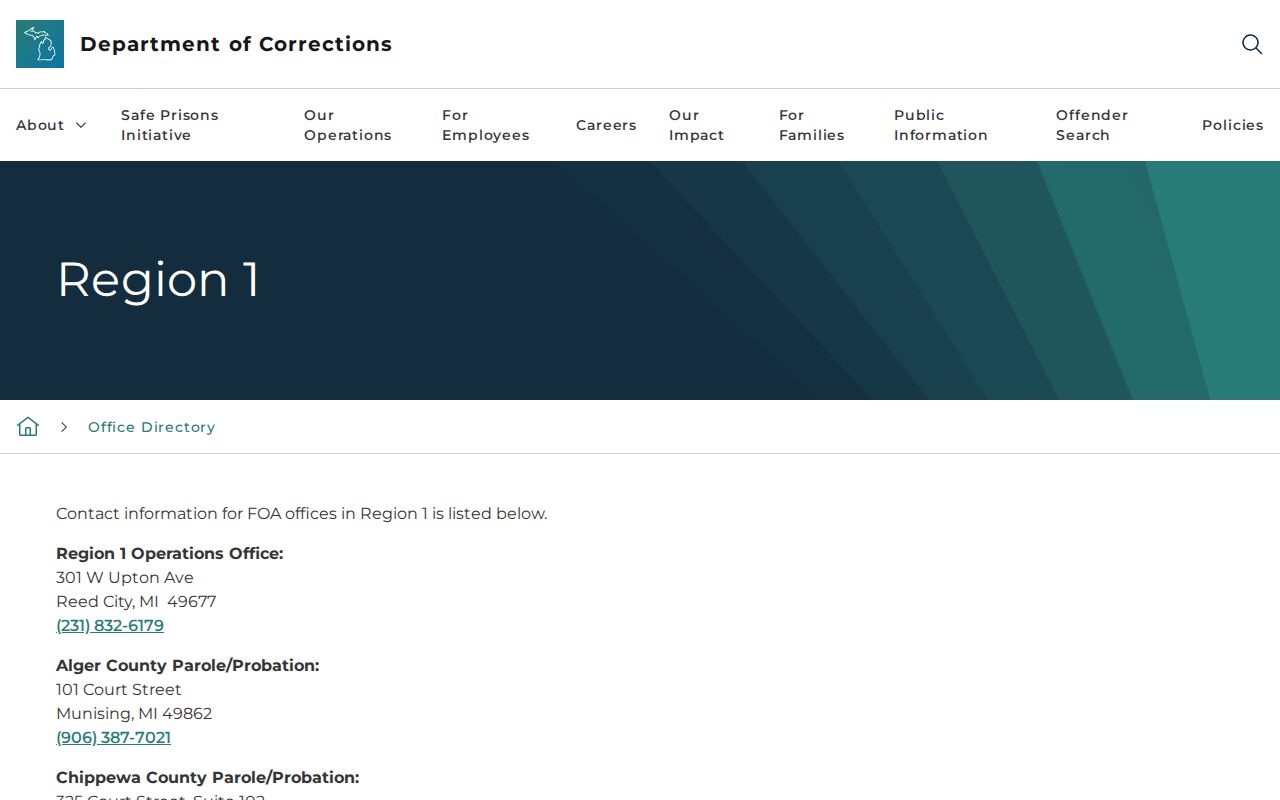
The listing helps confirm where public supervision questions should be routed, but the live OTIS record remains the person-specific source.
For Parole Board questions, the Board is Michigan's sole paroling authority for MDOC felony prisoners. Its general office handles parole process information, while the Delta field office handles local supervision. Ordinary parole interviews do not appear in a statewide name-by-name public calendar. The public hearing list is limited to lifer, commutation, and pardon matters, so absence from that list says nothing about an ordinary parole review.
Delta County Parole Status Problems
Supervision conditions are set for the person and case. They may concern reporting, residence approval, treatment, travel, contact, or other lawful requirements, but the public research does not supply any one person's terms. OTIS can show the broad status and supervising office. It should not be used to infer the details of an order that is not displayed.
An absconder label needs special care. It means MDOC alleges that the person did not report or cannot be located while supervision remains active. It is not proof of successful release from all custody, nor does it mean supervision ended. MDOC publishes an Absconder/Escapee Tip Line at 517-755-0855 and directs known whereabouts to law enforcement. Public OTIS information is a lead. Operational warrant confirmation belongs to authorized systems and the responsible agency.
A violation allegation also does not state the final outcome. The agency may investigate, impose an authorized response, or return the issue to a court or parole process. Custody may resume. When the question is whether Delta County currently holds the person, contact the Delta County Correctional Facility rather than treating an older community status as current proof.
The Michigan Sex Offender Registry is a separate and limited status source. It applies only to people covered by the registration law. A record may show Active, Incarcerated, Out of State, Absconder, or Homeless, but those labels concern registry status. They are not a general Delta County parole or probation search. Absence from the registry says nothing about supervision for a person who is not required to register.
Note: A supervision status can change after an online view, so confirm urgent Delta County custody questions with the office that owns the record.
Delta County Supervision Discharge Records
Supervision ends through a discharge recorded by the agency or court with authority over the sentence. In OTIS, DISCHRG means the person is no longer under MDOC supervision for that sentence. The context still matters because the MDOC definition can include successful parole or probation completion, discharge at the maximum without parole, or death before completion. A status label should never be expanded beyond what the record supports.
OTIS generally retains a public profile for three years after discharge. Older state records may require the MDOC records-retention or FOIA route. A court judgment, probation completion entry, or discharge order can supply the legal endpoint. If a correction is needed, a court-derived OTIS error goes to the sentencing court, while a current status or absconder issue goes to the supervising office. A Delta jail release field belongs with the Sheriff or county FOIA custodian.
The strongest closeout record pairs the endpoint with the right source. Date Paroled shows prison exit into supervision, not completion. DISCHRG shows the end of MDOC authority for the displayed sentence. A Delta County release entry shows the local jail stay ended, but it may state transfer rather than community release.
Delta County Release Property Questions
The official Delta jail page describes clothing intake for work or school release and work-van inmates, along with limited medical-item dropoff. It does not publish an outgoing property procedure, identification-return rule, or release-record correction process. Those gaps should remain explicit. Call the jail before making a trip for property or identification, and do not infer an exit process from visitation or intake rules.
Each correction question follows the record owner. Ask Sheriff Todd Tardiff's office through the Delta County Sheriff channel about jail data and the associated property procedure. Use the Delta County FOIA process for an existing release entry. Send a charge, judgment, or disposition error to the court. Contact the Delta County Parole/Probation Office for an OTIS supervision field, except when the disputed content came from a sentencing court.
This local split prevents one office from being asked to rewrite another agency's record. A release order, physical exit entry, and supervision record are complementary. Together they show legal authority, the end of one custody episode, and the next status.