
Delta County Scheduled Versus Actual Release
A scheduled or projected date is a calculation based on the current sentence record, the applicable credit rules, and known holds. It can identify an eligibility point or a potential endpoint. It is not proof that the person walked out. An actual release date is the agency's record that a custody episode ended. Even then, the disposition must be read because a transfer from the Delta County Correctional Facility to MDOC, another county, federal custody, or immigration custody is not a return to the community.
Michigan's state fields have precise labels. OTIS uses Earliest Release Date for the earliest point at which the Michigan Parole Board may have jurisdiction. Date Paroled is the stronger prison-exit field. Maximum Discharge Date is the potential outer endpoint for MDOC authority on the sentence. A favorable parole action can still be delayed, suspended, or rescinded before physical exit. These terms cannot be swapped for one generic projected release date.
Pretrial custody follows a different track. There is no sentence from which to compute a release date. Bond payment, a signed order, dismissal, acquittal, plea, sentencing, or another hold may change the status. The 94th District Court docket can show legal authority, but Sheriff Todd Tardiff's jail staff must confirm whether release processing finished.
Find a Delta County Release Date
Begin with the system that holds or most recently held the person. The MDOC Offender Tracking Information System is for state prisoners and people under state parole or probation. It does not include someone sentenced only to the Delta County jail. The Delta County Correctional Facility, the sentencing court, and the county release record are the local path.
- Identify whether the person is pretrial, serving a Delta County jail sentence, committed to MDOC, or held by another sovereign.
- For MDOC custody, search OTIS by MDOC number or last name and confirm all identifiers before opening the record.
- Read status first. Then distinguish Earliest Release Date, Date Paroled, and Maximum Discharge Date.
- For a county sentence, review the judgment and jail credit with the proper Delta court, then ask the Sheriff for the current computation or existing release entry.
- For a pretrial case, check bond and signed court events, then call the jail to learn whether Delta still holds the person.
- If another warrant, detainer, or receiving agency appears, continue with that agency. Leaving Delta custody may be a transfer.
- Use a narrow Delta County FOIA request when durable proof of the actual release date, time, type, or receiving agency is needed.
The OTIS page below is the official state entry point captured in the manifest. The MDOC offender search states its coverage limits and provides access to the search form.
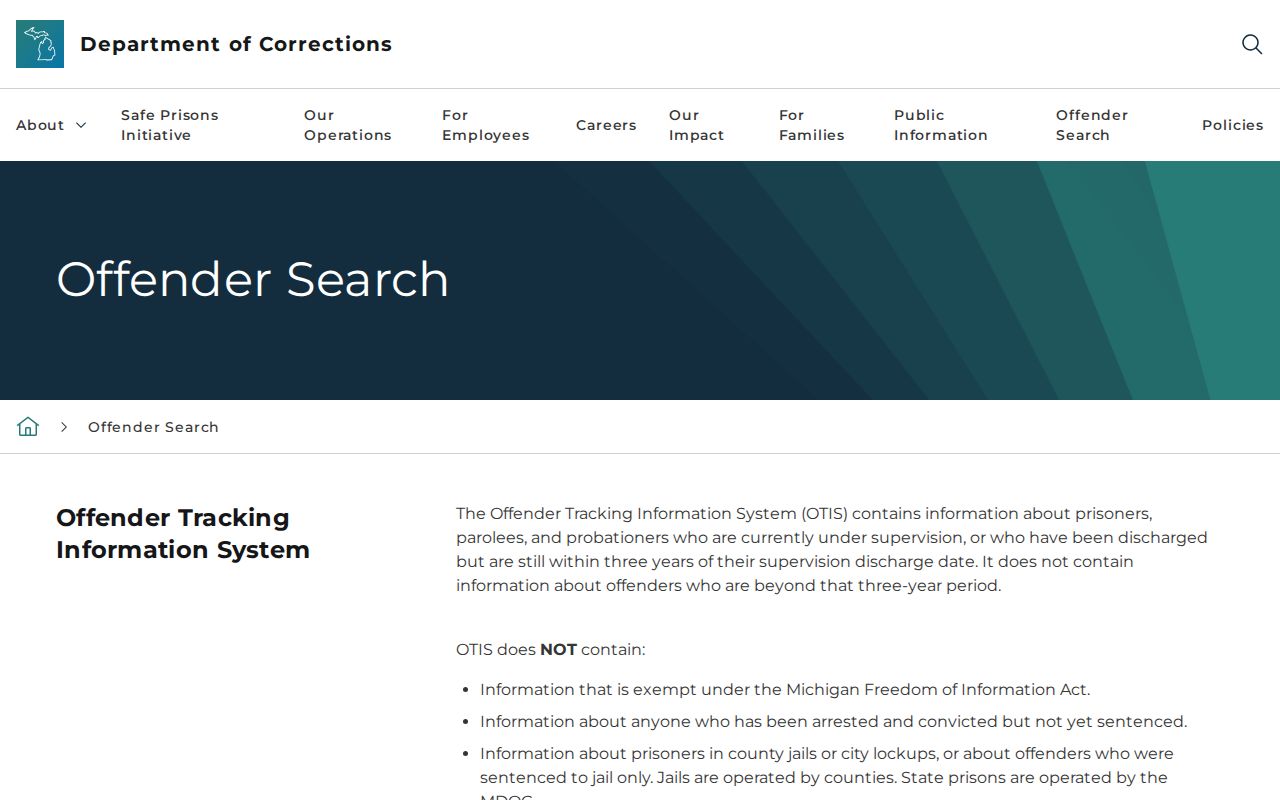
The state portal helps with prison and supervision records, while a Delta jail-only release remains a county record.
For a broad named-person workflow across county, state, court, federal, and immigration systems, use the Delta County released inmate search. A negative online result always routes back to the custodian. It does not establish release.
Delta County State Release Eligibility
Michigan truth in sentencing controls many modern state-prison terms. For covered prisoners, specified assaultive crimes committed on or after December 15, 1998, and other crimes committed on or after December 15, 2000, generally require service of the entire minimum before parole consideration. Michigan's rule is 100% of the minimum for covered offenses. It is not the federal shorthand of roughly 85%, and describing it that way would be wrong.
Truth in sentencing removed good time and disciplinary credits as ways to shorten the minimum for covered terms. It also bars corrections-center placement before that minimum. Once the full minimum is served, the Parole Board may consider the case. Eligibility does not compel a grant. The Board may grant, deny, or defer based on its statutory process, and adverse information or misconduct can affect an action before exit.
The official Michigan truth-in-sentencing explanation shown below states that covered prisoners serve the full minimum before parole eligibility.
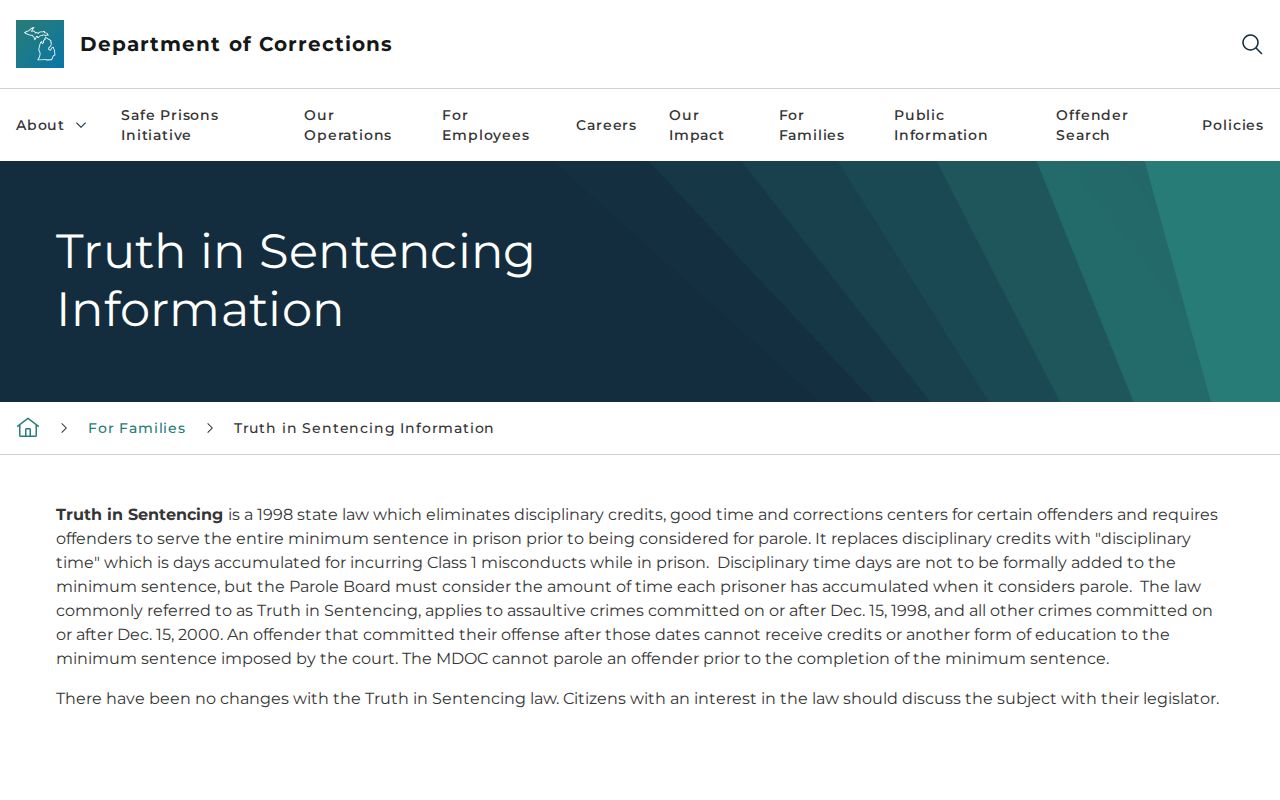
This state rule applies after a Delta County felony commitment to MDOC. It does not calculate a local county jail sentence.
Consecutive state terms can aggregate minimums and maximums under MCL 791.234. For older or other cohorts with applicable credits, MDOC says the displayed Maximum Discharge Date may assume available credits and can increase when the warden does not grant them. The offense date and sentence structure therefore matter. A public search field cannot replace the judgment or MDOC computation.
Note: Delta County court and jail records establish the commitment and local exit, while OTIS tracks the later MDOC sentence and supervision stages.
Delta County Jail Good-Time Rule
A sentenced Delta County jail prisoner falls under a different rule. MCL 51.282 provides one day of sentence reduction for each six days served when the prisoner has no rule violations. The Sheriff may prescribe forfeiture and can restore lost good time for a minor infraction. This is the local one-for-six framework, not the MDOC truth-in-sentencing rule.
The formula is only one part of the actual date. The jail must account for credit already served, the judgment, concurrent or consecutive terms, amendments, and any lost or restored good time. Other warrants and holds can change where the person goes when the Delta term ends. Administrative completion also matters, but Delta County publishes no release-processing schedule or exact lag. A reader should not calculate a guaranteed exit time from the arrest date or a news report.
The Legislature's official display of Michigan's county-jail good-time statute appears below.
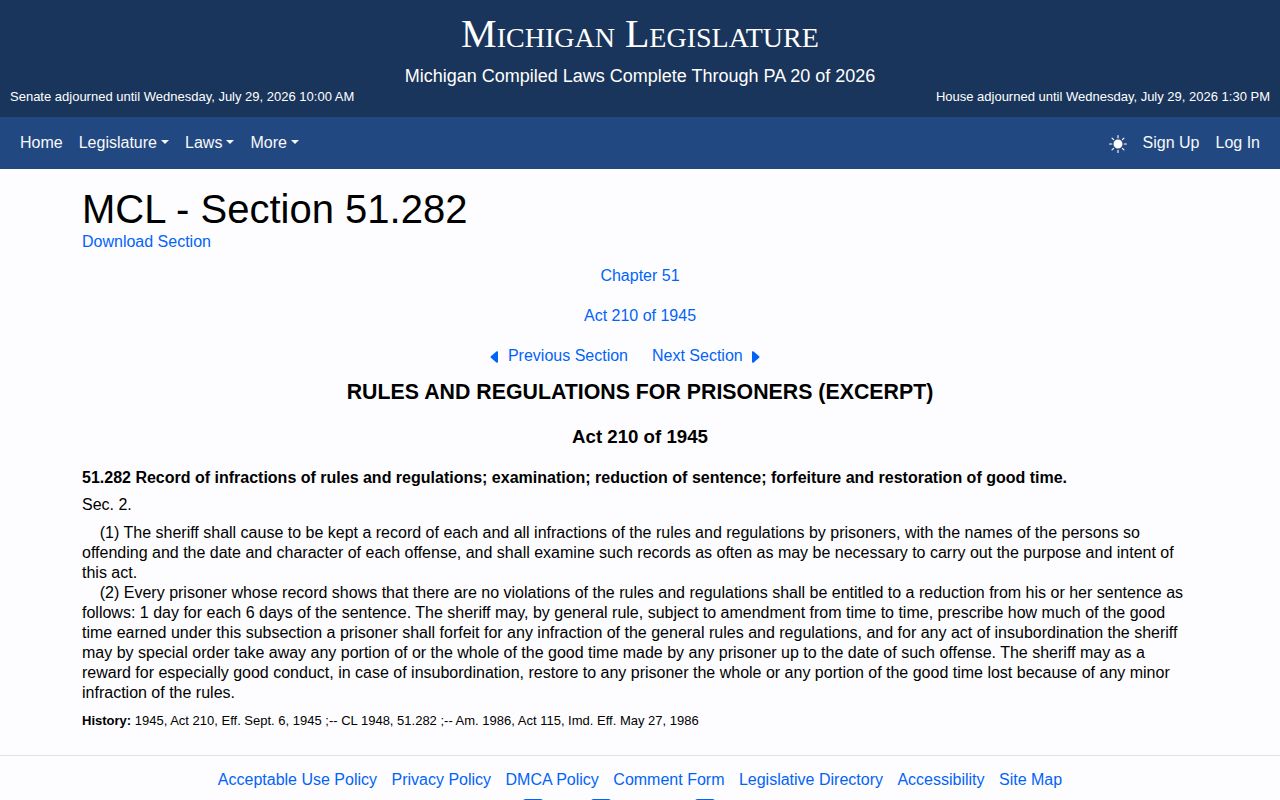
The statute provides the credit rule, while the Sheriff and court records supply the case-specific dates and any adjustments.
Do not apply one-for-six credit to a pretrial detainee. That person is not serving a fixed county jail sentence for this purpose. Bond, a court order, disposition, or another hold controls the exit. Likewise, do not apply county good time to a covered MDOC minimum.
Why Delta County Release Dates Change
A date can move because the underlying facts or legal authority change. Some changes affect the calculation. Others affect whether the person leaves one agency for the community or for another custodian. The record should identify which system made the change and which field moved.
| Factor | Possible effect | Best confirming source |
|---|---|---|
| Jail good-time loss or restoration | Changes a sentenced county jail computation | Delta Sheriff calculation or release record |
| Court amendment or jail credit | Changes the lawful term or time credited | Signed judgment and jail record |
| Concurrent or consecutive terms | Changes how minimums or maximums combine | Court judgment and MDOC computation |
| Parole grant, denial, or deferral | Changes the path after eligibility, not the minimum already served | Parole record and OTIS status |
| Misconduct or new adverse information | May suspend or alter a pending parole action | MDOC record |
| Warrant, detainer, or receiving hold | May turn a community release into a transfer | Holding and receiving agency records |
A court order can authorize release before the jail completes identity checks and other lawful processing. Bond payment can begin the same path without proving physical exit. Delta County does not publish a standard release hour, weekend rule, or processing estimate. Same-day confirmation should come from the jail.
Note: A transfer ends one custody episode, but the receiving agency record is needed before calling the event a community release.
Delta County Release Date Split
Michigan's state and local rules create a sharp boundary. A covered state prisoner generally must serve 100% of the minimum before the Board may consider parole. A sentenced county jail prisoner can earn one day off for each six days under MCL 51.282 if no rule violation changes the credit. Earliest Release Date is eligibility. Maximum Discharge Date is a different potential outer boundary. Neither is the same as Date Paroled.
This distinction resolves many apparent conflicts. A Delta court judgment may show the local sentence or the commitment to MDOC. The Sheriff records the end of Delta custody. OTIS then becomes the state record after a prison commitment. If the person stays in the county jail, the court and Sheriff remain the proper sources. Mixing the two formulas can produce a false date.
Ask for the smallest record that answers the question. For a projected state eligibility point, read OTIS and the judgment. For a county calculation, request the existing jail computation or release entry. For actual exit, use Date Paroled or the facility release record. For the destination, inspect the disposition and receiving agency.
Confirm Delta County Actual Release
Automated notice can help track a pending custody change, but it is not the final record. The Delta County VINELink Release Check explains how MI-VINE alerts work for participating agencies. A released or out-of-custody notice means only that the reporting agency no longer holds the person. It does not rule out another county, MDOC, federal custody, or ICE.
For local proof, request the Delta County jail entry showing actual release date and time, disposition, and receiving agency if recorded. Compare it with a signed bond, dismissal, judgment, or other court order. For state prison, use Date Paroled or the institution's release record, then read whether parole remains active. For federal custody, use the BOP record rather than OTIS.
When records disagree, send the issue to the owner of the field. The court corrects its judgment. The Sheriff owns the county release entry. MDOC handles state status, with court-derived errors routed back to the sentencing court. That chain keeps a date tied to its source and prevents an estimate from being reported as fact.